Nobody hands you a manual for taking a Dutch barge from Oxford to Istanbul. Every week brings something new: a filter, a pump, a fuse, a tide we misjudged. These are the notes we wish someone had given us before we set off.
Navigation · August 2024 · Oxford
Folly Bridge
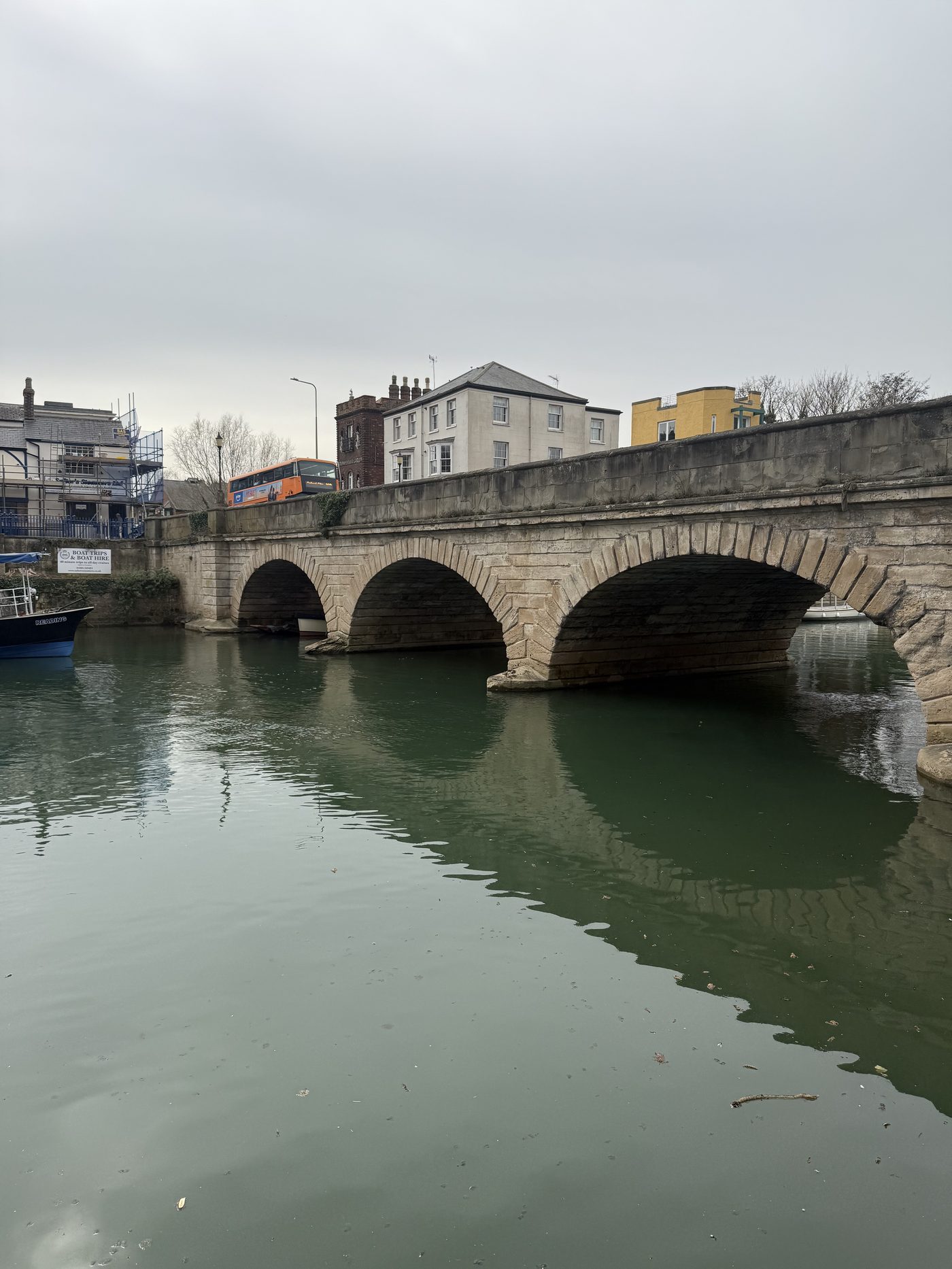
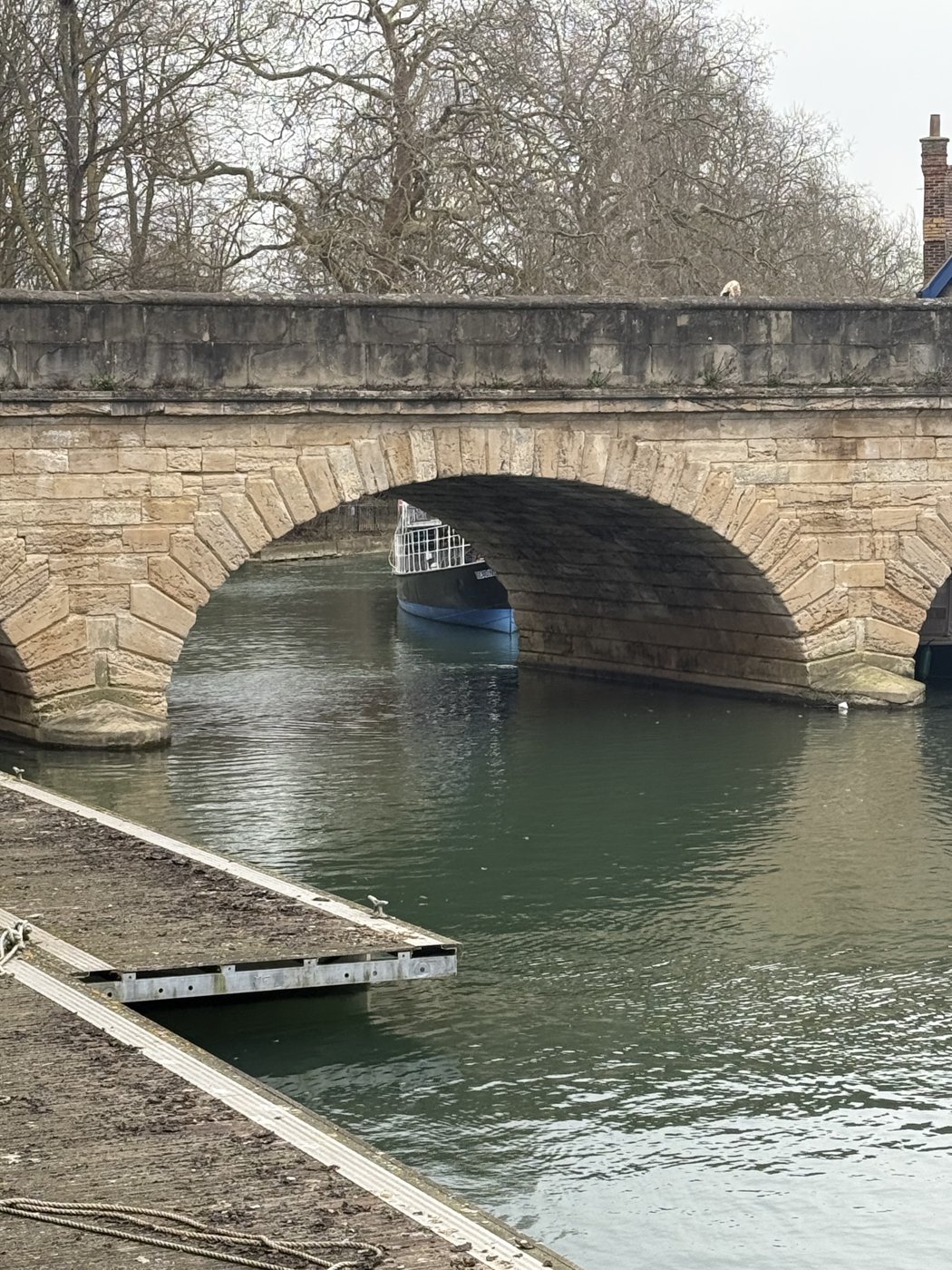
Folly Bridge is a foolhardy undertaking in a Piper 65M. I didn't know that before I undertook it. Having walked and driven over it many times I had in my mind it was a large bridge. But actually, from the wheelhouse of our vessel as we approached it, I realised it was, in fact, a very, very small bridge.
We inched slowly towards it, and I asked Kate to let me know if we would fit under. She said nothing. So we crept forward, and the wheelhouse slipped under the bridge. As close as close can be. We were totally committed and half-way through when Kate cried "STOP!". Blow me down, I stopped instinctively. "Why?" I cried back. We were frazzled. I didn't wait for an answer; I just knew stopping where we were was a bad idea. I moved us forward again, and there was a gentleman in a boat on the other side who actually applauded our exit. Not a scratch to be seen. However, I estimate we had a centimetre or two each side, and if I had solid solar panels on the wheelhouse roof they would have been ripped off. Unfortunately for us, we had to do the return journey a few days later which was handled badly by me. I needed to accelerate towards the bridge in the last 50 metres or so on the straight stretch to maintain steering control with the strong downstream flow following days of rain. In retrospect, I should have gone through backwards, but I didn't even know that was a navigation technique at the time. Going under Folly Bridge with the current has to be one of the top 3 scariest moments on Che Bella Vita. And I am so grateful I didn't appear on that night's evening news as being the idiot who crashed into the bridge on his shiny new boat. I was however literally centimetres away from doing so.
Navigation · October 2024 · Dover
Smashing the China
The first time we 'Smashed the China' was leaving Dover. We had only encountered smooth sea conditions prior to that. But leaving Dover we were in slight seas, i.e. waves to about 1.25 metres. However, this does not mean the biggest wave will be 1.25 metres. No sir. And for our Dutch Barge, designed as she is to navigate shallow waters with a flat bottom, a 1.25 metre wave is a large wave. We were hitting waves nearer 1.75 metres, really uncomfortable and quite unexpected. Fortunately they were coming from the bow, not the side. But nevertheless the rolling was substantial, and downstairs it was bedlam.
Poor Kate, she was downstairs dealing with the fact that anything not strapped down was being flung everywhere. All the drawers flew open, and plates, cups, glasses, vases, ornaments and cooking implements were spilling out and smashing. Lesson learned!
Now when we expect waves, we lay everything fragile on a bed or the sofa. We tie the drawers down so they can't open. We take the pictures and mirrors off the wall. And we make sure the galley surfaces are cleared.
Hull & deck · February 2025 · Bristol Channel
Serious Water Ingress - we've got Problems!
Crossing the Bristol Channel, in February, in the dark, we encountered a frightening difficulty: water was coming into the engine room from the sea! The attached video only shows the flow when the engine was at low revs. At higher revs, the volume increased substantially.
I can't even recall now why I looked into the engine room at all, but something was bothering me about the way the boat was handling. There were a couple of inches of water in the bilge by the time I looked. And thank heavens I did look! There was a clear crack on the steel shoulder surrounding the rudder shaft.
We were outside the main channel at this point, but needed to cross it to get back to Portishead. I put the engine below 1000 RPM, filmed the leak, then turned the bilge pump on. I was seconds away from calling a pan-pan. Fortunately, the bilge pump on Che Bella Vita is effective, and the sandy water coming in from the Bristol Estuary was not blocking it. I figured it would take an extra hour, but if we limped home and the leak did not develop any further, we would be OK.
So limp we did. Which led to one unfortunate encounter with a large cargo vessel. As I crossed the shipping lane, being careful to take the perpendicular route across, a vessel that was over 5 miles away when we started was right on top of us within minutes. I saw him getting closer and closer on the AIS, but couldn't believe he could close so quickly, so I maintained heading and speed. But my word, he did close quickly. His searchlight came on, and I was relieved he obviously could see us. We were by now across his path and moving out of his way. When he passed behind, I estimate 100 metres was all there was between us.
When we arrived at Portishead, a call from Bristol VTS awaited me. I'd expected to receive a bollocking, but actually the gent I spoke to was very calm and reassuring. He said the captain of the other vessel had informed him (not complained) that he had had to alter course, and that our steaming light was too bright for him to make out our nav lights.
To fix the leak, I needed an engineer to fit a new shoulder to the rudder shaft. I'd spoken with Joe at Pipers, who, in the most gracious way possible, intimated that my mechanical skills might not be up to it. And how right he was!
Water entering around the rudder shaft at low engine revs. At higher revs, the flow increased substantially.
Engine · April 2026 · Bristol Estuary
Water in the Diesel
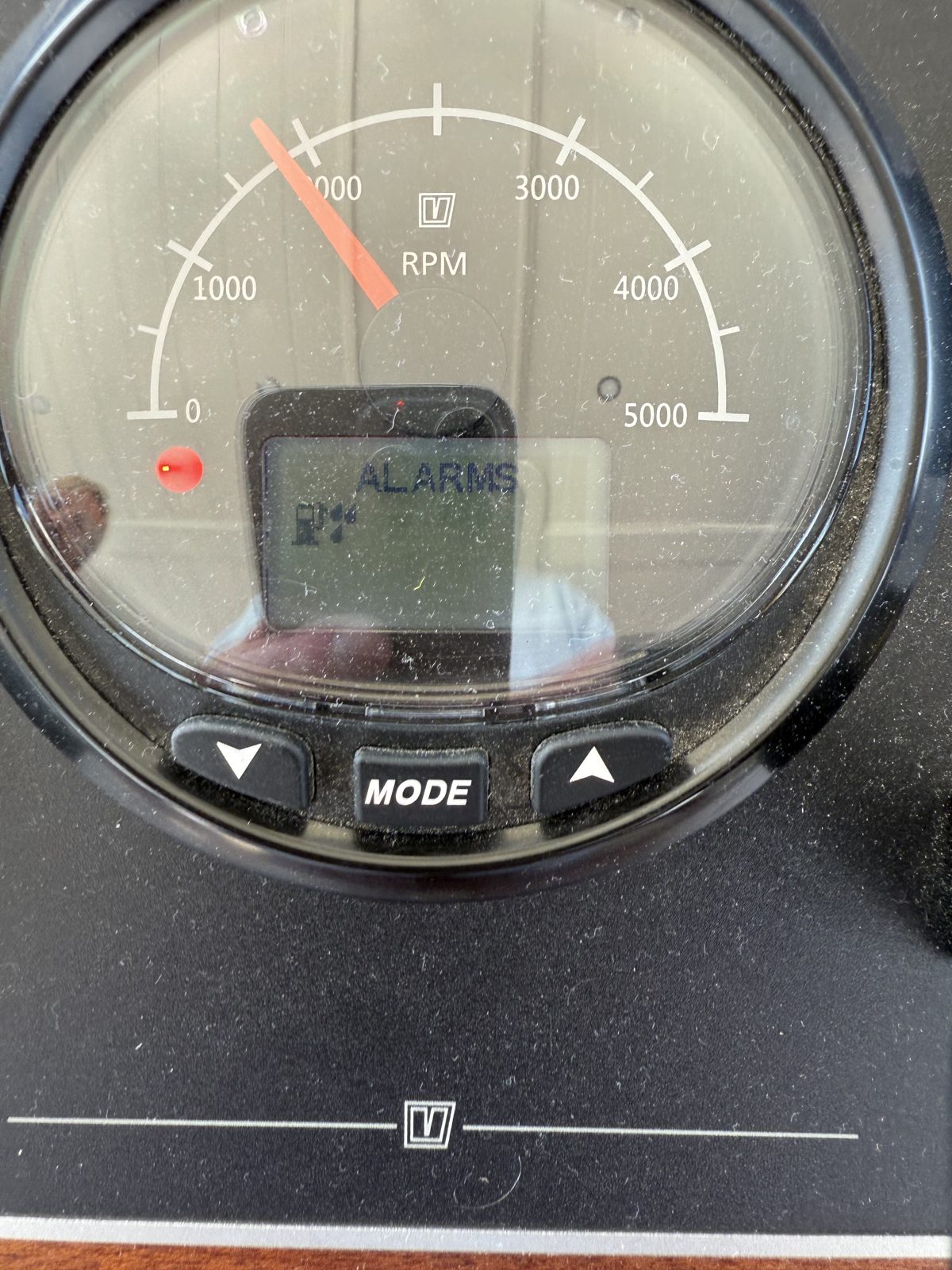
We were on the run into Cardiff, about 30 minutes out, when we encountered a new alarm on the dashboard. The alarm indicated "Water in the Water Separator". I turned the engine off, and restarted it (an old trick I learned in IT support!), but the alarm came back.
I didn't know what to do so limped into Cardiff at low revs. Fortunately, Che Bella Vita got us there safely alongside.
On Che Bella Vita we have two filters in the fuel journey (the journey fuel takes from the fuel tank to the engine to be burned to deliver power). The fuel journey is in two parts: the low pressure part which is essentially safe to maintain, and the high pressure part which is highly dangerous and must never be touched unless you are an engineer. On the low pressure line there are two filters: a "water separator" whose job is to remove water from the diesel, and then a second filter which removes other contaminants and hopefully any remaining water.
The dashboard alarm comes from the first filter. There is a water sensor that triggers the alarm. So what needed to be done was to drain the water from the water separator. Not a particularly difficult job, but a bit messy and required quite a bit of diesel clear-up afterwards.
Once done, the alarm disappeared and we were able to sail away the next day with no problems. The question I should have been asking myself though was "why is there water in my diesel? And how do I get it out?"
Draining the water from the water separator: gloves on, bowl underneath, and the drain tap cracked open until what comes out runs clear.
What we did next: the Diesel Dipper
That question about getting water out of the diesel led us to buy a Diesel Dipper. Josh and Woz fitted it during the new engine work in September 2026 (see New Engine).
These films follow on from the original water separator story above. They show maintenance of the Diesel Dipper, not the engine's existing water separator, and were filmed at Whitehaven on 26 October 2026.
Changing the filter
The filter change is shown in four parts, kept in sequence with the original sound.
Changing the Diesel Dipper filter, part 1 of 4.Changing the Diesel Dipper filter, part 2 of 4.Changing the Diesel Dipper filter, part 3 of 4.Changing the Diesel Dipper filter, part 4 of 4.
Draining the water
The fifth film shows how to drain water from the Diesel Dipper. A separate job from changing its filter, and another part of looking after the fuel aboard Che Bella Vita.
Draining water from the Diesel Dipper.
Engine · Early May 2026 · Irish Sea
Black Smoke in the Exhaust
We first spotted black smoke in our exhaust on the run into Conwy. It wasn't too concerning at the time, and didn't prompt an investigation as it only happened at high revs. It happened again on the run into Preston; we needed to move out of the way of a survey vessel. The smoke lingered long after we left. I was slightly concerned... But again, it didn't prompt an investigation. When we left Preston, the consequence of that became clearer. Navigating the Ribble is a little tricky; it is narrow and we had to get over the sea bar before the tide went out too far. So power was needed. And power wasn't there; Che Bella Vita would only deliver half power! I should have paid more attention to that black smoke!
Black smoke in the exhaust can have several causes, but the root explanation is that there is not enough air being taken in by the engine to burn all the diesel. So uncombusted carbon particles are fed into the exhaust which is why the exhaust is black and lingers. In our case it was probably a clogged air filter. Or maybe something to do with all that water that had appeared in the diesel (see Water in the Diesel).
Now I was at sea with only half-power, on a night passage to Fleetwood, and unable to fix the problem. I called the coast guard to let them know. They were fantastic and called back every hour to check our progress until we were alongside in Fleetwood at 4am.
Engine · May 2026 · Fleetwood
Replacing the Filters
Having had the power loss at sea, and following advice from HWKE, I decided it was time to replace the water separator and the secondary filter. It seemed straightforward enough in the manual. I bought myself a tool to remove filters (a 'filter strap'). I already had the spare filters to hand. I turned off the fuel shut-off valve and had at it. Several hours later, I left the wheelhouse feeling dejected that after all my efforts the engine would not start. (see Hydrolock Disaster)
Removing filters is not as easy as it appears. And replacing them properly even less so. There are risks around air blocks, not tightening sufficiently, or over tightening. You have to ensure the new filters are sealed properly. And you need to fill them with clean diesel before you attach them. Easy perhaps for experienced mechanics, but for me it was stressful, dirty and ultimately fruitless work. In fact, I had taken a major step backwards because by doing this 'routine maintenance' I had in fact laid the foundation for a hydrolocked and ultimately ruined engine.
Engine · May 2026 · Fleetwood
Hydrolock Disaster
Having replaced the water separator and the secondary filter (see Replacing the Filters), I tried to start the engine. The engine turned over, but would not start.
It turns out, I tried to start the engine too many times. In fact, when I subsequently spoke with a Vetus engineer, he said to me the engine start should not be attempted more than twice! Twice? Where does it say that in the manual supplied with the engine? It doesn't. "But everybody knows this" explained the engineer. Well, I didn't. In fact, there are no warnings or instructions in the documentation that might have helped me avoid the mistake I was making. And the cost of that mistake was dire; with each attempt to start the engine I was sealing its doom, and ultimately the engine completely needed replacing. So I am hoping this might help you avoid a similar disaster.
Here is what to do, and what not to do, as far as I now understand it. A hydrolock condition is caused when an attempt is made to start the engine, and water is brought in. But there is not enough power to push the water out again (because the engine does not start). So each crank adds more water, and as it has nowhere to go, the pressure builds. Eventually something goes pop. And in my case it was the starter motor which completely fractured.
Here is what I should have done. Attempted to start maybe twice. Then I should have shut off the sea cock for the water intake. And I should have bled the low pressure fuel line (even though the engine is described as 'self-bleeding'; it isn't!). Then I should have tried to restart again, and once the engine fired, then I should have opened the sea cock for the water to enter.
Engine · 7 September 2026 · Fleetwood
New Engine
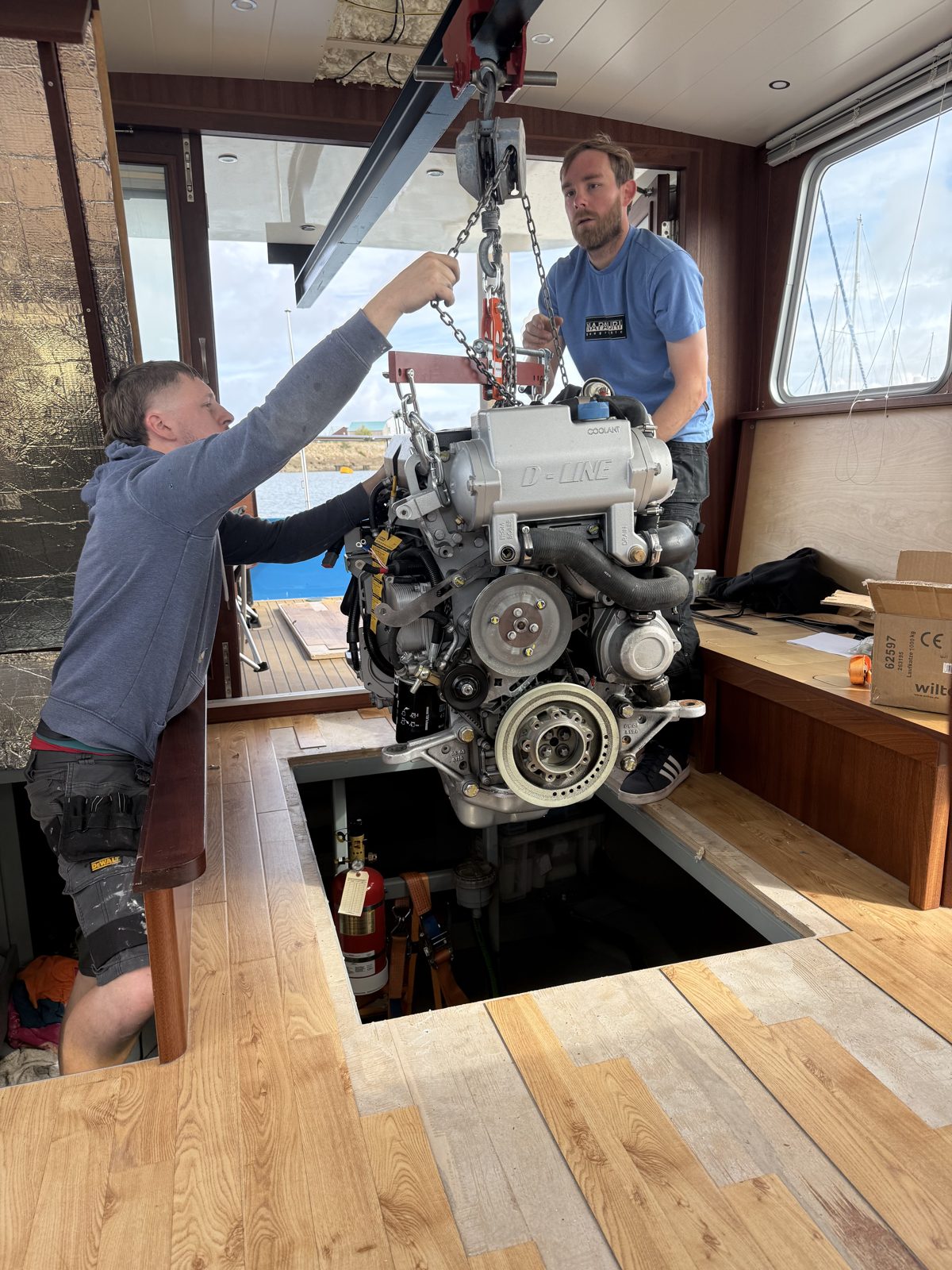
Josh and Woz turned up today to replace the engine. They are amazing. This is what I wrote to HWKE shortly afterwards.
I wanted to let you know of Josh's and Woz's visit this week.
Josh and Woz were just exceptional. Kate and I spent most of the time they were here gobsmacked at their technical and engineering ability. Marry this with their natural cheerfulness, helpfulness and willingness to do what is needed to get the job done and we were just over the moon.
On day 1, they began work at 7am, they must have left home around 5am to get here, and they continued working to gone 8pm. A lot of that time they had to be out in the pouring rain, clambering across a dredger and up a sheer wall quayside.
They helped Kate and I move the boat from one end of the harbour to the other, manning the ropes. This was definitely going above and beyond. But without their help I would have really struggled to get the boat to the crane.
By 7pm they had removed the old engine, fitted the new engine and fired it up, and then stayed on to ensure it was safe while we moved the boat to a secure mooring. I couldn't have asked for anything more.
But more was to come...
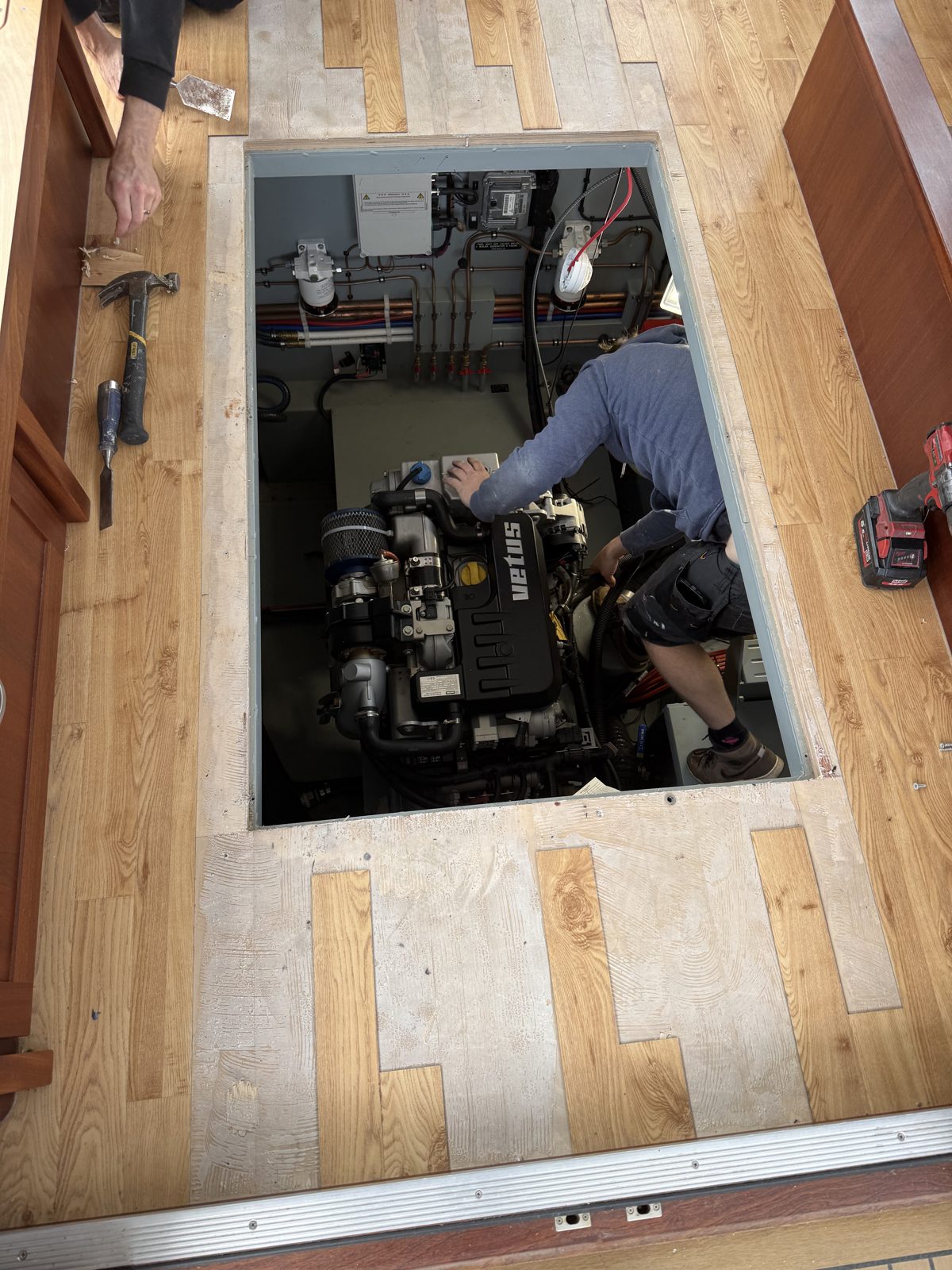
On day 2, the diesel dipper was fitted. This required new pipework. The wheelhouse flooring was completely relaid. The engine was tested under load. All our other questions were answered. Then they ensured the engine room and wheelhouse were made spotless. There was literally nothing more we could have wanted.
I remember when we first bought Che Bella Vita, and witnessing Josh and Sean commission it in the baking heat, with no shade, and at the end of what must have been an exhausting day staying on to pump up my tender and secure it to the davits. And then drive home again from Harleyford to Cheshire at the end of the day. An 11 on 10 performance.
And now another 11 on 10 performance from Josh and Woz.
Kate and I are just bowled over, and truly grateful. We can't wait to get back to sea on our next leg up to the Caledonian and it is all down to what we believe to be a truly excellent Piper team.
Well done to everyone there that this level of performance seems to be unremarkable. To Kate and I it is fabulous. We are once again truly delighted with the help, support and expertise we have received from Pipers and could not wait to write and tell you about it.
A massive thank you!
And here are some photos of these guys at work. Outstanding.
The new engine arrives through the wheelhouse floor.Josh and Woz at work in the engine bay.